

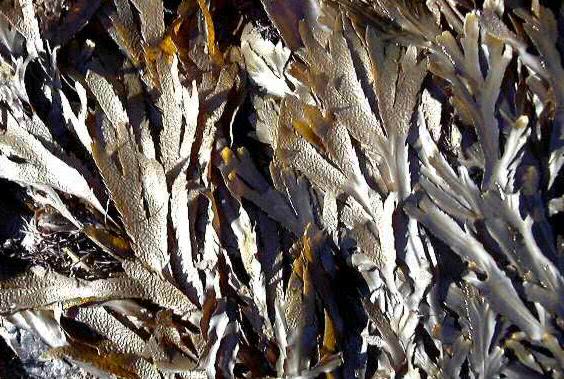
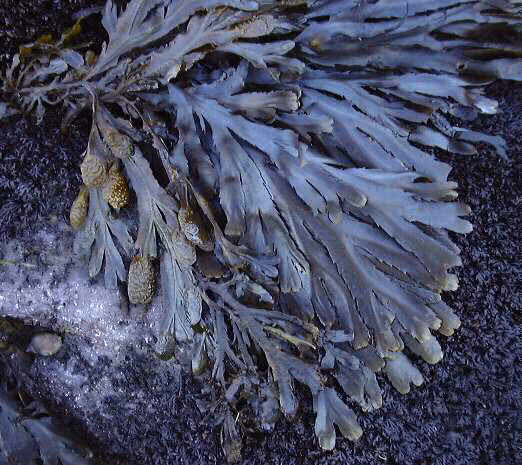
This is a very flattened wrack which grows in heavy bunches of fronds, up to 50 - 80 cm in length. It has distinct dark brown fronds with a strongly serrated edge and no bladders. With close inspection clusters of small white hairs can be seen on the frond. In very sheltered conditions the fronds become curled and the entire plant becomes more bulky.
This abundant Fucus alga can form dense layers on the lower shore of rocky seashores. The commonest species of the lower shore. Widespread from northern Scandinavia down to the Bay of Biscay
Like most wracks this lives for 3 years and grows very
well on slow draining shores where it may occupy a third of the
area of the entire seashore. It is intolerant of desiccation,
with a cell wall thickness 0.42 micrometers. With the flattened
fronds only the top surface of the frond dries at low tide. The
growth, form and breeding is variable being related to climate
and temperature, e.g. the fronds are longer with fewer branches
in the north Scotland compared with shorter, much-branched individuals
in the English Channel. Also, with increase latitude, it is found
higher up the seashore.
It intolerant of heavy wave action and at such times it is replaced
by Himanthalia elongata. Like many other algae of the lower
shore it is adapted to low light intensity by developing additional
pigments for absorbing what little light is penetrating the water.
One of the reasons that lower shore examples are almost black,
absorbing all the light.
Under sheltered conditions a wide range of epizooites, such as
tube worms, bryozoans and hydroids, colonise the fronds. The most common
of these is Spirorbis, a small polychaete worm which secretes a
calcareous, spiralled tube (diameter 3mm). Many epizoites are filter feeders
and use the algal frond as an attachment only, some protection from dehydration may be an added benefit. The sexes are separate unlike the Fucoids of the upper shore
and the receptacles containing these reproductive parts are more
streamlined at the tips. Like the bladder wrack, female gametes
produce chemical attractants (pheromones)to attract the male.
This is called fucoserratin.
Looking for a next step?
The FSC offers a range of publications, courses for schools and colleges and courses for adults, families and professionals that relate to the seashore environment. Why not find
out more about the FSC?

FEEDBACK
Do you have any questions?
Copyright © 2008 Field Studies Council

Creative Commons Attribution-Noncommercial-No Derivative Works 3.0 Licence .
Site Statistics by Opentracker
